Bee Learnt Logo
Bee Learnt
FeatureBrowse allPricingAboutSupport
Bee Learnt

Bee Learnt gives South African Grade 10–12 learners a cleaner route from classwork to NSC readiness — with parents and tutors supporting the journey.

WhatsApp: 0685537312

Support email: admin@beelearnt.co.za

Learn
FeaturesBrowse subjectsPricing
Get started
Create accountSign inContact support
Company
About Bee LearntAdvertisingContact
Legal
Privacy policyTerms of serviceCookie policyAd choices

© 2026 Bee Learnt. All rights reserved.

CAPS aligned · Grades 10–12 · NSC ready

Privacy choices

Allow analytics and advertising services to help us understand site usage and measure campaigns.

Privacy Policy
  1. Subjects
  2. /
  3. Physical Sciences
  4. /
  5. Grade 10 Physical Sciences Theory
  6. /
  7. Atomic structure
  8. /
  9. The atom and its particles
Grade 10 · Theory

The atom and its particles

Atomic structure · about 3 min
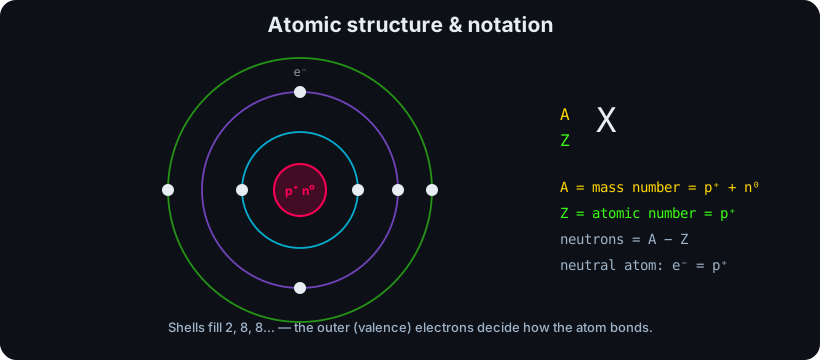
Atom with nucleus and three electron shells, plus mass and atomic number notationNucleus, electron shells and the A/Z notation.
1 MIN READ
2 study sections · pause after each one and recall the key idea

Atoms are built from three particles, and their arrangement explains every chemical property.

Key points
  • Protons (+1) and neutrons (0) sit in the tiny, dense nucleus; electrons (−1) occupy shells around it.
  • Atomic number Z = number of protons — it identifies the element.
  • Mass number A = protons + neutrons; neutrons = A − Z.
  • A neutral atom has equal protons and electrons.
Key terms
  • Nucleus — the dense centre containing protons and neutrons.
  • Atomic number — the proton count, unique to each element.
EXAM TIP

notation ᴬ₂X packs everything — A on top, Z below; neutrons are always the subtraction A − Z.


Next

Isotopes and relative atomic mass