Bee Learnt Logo
Bee Learnt
FeatureBrowse allPricingAboutSupport
Bee Learnt

Bee Learnt gives South African Grade 10–12 learners a cleaner route from classwork to NSC readiness — with parents and tutors supporting the journey.

WhatsApp: 0685537312

Support email: admin@beelearnt.co.za

Learn
FeaturesBrowse subjectsPricing
Get started
Create accountSign inContact support
Company
About Bee LearntAdvertisingContact
Legal
Privacy policyTerms of serviceCookie policyAd choices

© 2026 Bee Learnt. All rights reserved.

CAPS aligned · Grades 10–12 · NSC ready

Privacy choices

Allow analytics and advertising services to help us understand site usage and measure campaigns.

Privacy Policy
  1. Subjects
  2. /
  3. Physical Sciences
  4. /
  5. Grade 11 Physical Sciences Theory
  6. /
  7. Vectors in two dimensions
  8. /
  9. Forces on an incline
Grade 11 · Theory

Forces on an incline

Vectors in two dimensions · about 3 min
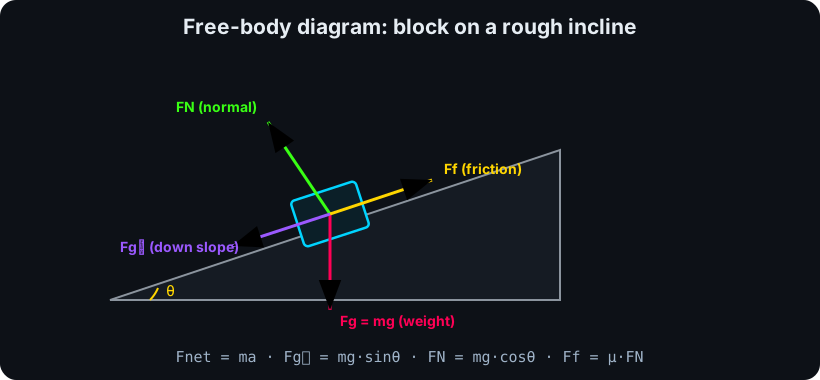
Free body diagram showing weight, normal force, friction and the component down the slopeForces on a block resting on a rough incline.
1 MIN READ
2 study sections · pause after each one and recall the key idea

On a slope it is far easier to tilt the axes so one lies along the incline.

Key points
  • Component of weight down the slope: Fg∥ = mg·sin θ.
  • Component perpendicular to the slope: Fg⊥ = mg·cos θ, which equals the normal force FN.
  • Friction acts along the surface, opposing motion or its tendency: Ff = μFN.
  • The object slides when the component down the slope exceeds maximum static friction.
Key terms
  • Normal force — the surface's perpendicular push.
  • Coefficient of friction (μ) — the roughness ratio.
EXAM TIP

on an incline the normal force is NOT mg — it is mg·cos θ, and forgetting this breaks the friction calculation.


Previous

Forces in equilibrium